Subscribe to our E-Letter!
Subscribe to our e-mail and stay up-to-date with news and resources from street vendors around the world.
When Mariama Issah, a member of our affiliate UNIWA in Ghana, looked at the women in her community, she didn’t see strangers. She saw neighbors carrying burdens they couldn’t carry alone. She saw women who needed someone in authority to speak for them. So she volunteered.
Mariama learned that vendors in the local market were being extorted. Officials were collecting money from them without issuing receipts, and the vendors had no idea where their money was going.
The vendors came to Mariama with their frustration. They shared with her that they were paying large sums of money they couldn’t afford to lose but with nothing to show for it. As people who were trained with negotiation skills, she stood up to use what she learned and apply it in real life.
At first, Mariama was afraid. Speaking out against local officials is not easy, especially considering she is a woman in a leadership role. But she didn’t let the fear consume her.
“I became the bridge between my community and those in authority. When I decided to stand for a position of a Unit Committee member, I discussed with some community members and they agreed hence they elected me as the Unit Committee Member for the fact that ever since, I was already helping women in our community in the difficulties they go through in the market” she said. In Ghana, a Unit Committee is the foundational, lowest administrative tier of the decentralized local government system. It functions as a grassroots consultative body designed to bridge the gap between local citizens and higher-tier authorities like the Town/Zonal Councils and Metropolitan, Municipal, or District Assemblies (MMDAs).
“When the vendors came to me with a complaint about their money being taken without a proof of payment, I decided to report the municipal officials to the Municipal Chief Executive (MCE) at the assembly,” she explained.
Thankfully, the answer from the MCE was satisfactory as it was ruled out that any payment a vendor makes must come with a receipt as evidence. In addition to that, Mariama and her colleagues took the lead of the market to make sure there is transparency in handling the money for the vendors. That decision changed everything since Mariama didn’t just keep quiet, but she acted to make changes in the community.
The hardest part wasn’t confronting the officials but rather, it was convincing the vendors to speak. Many were terrified. “They feared that if they spoke out, they would be sacked from the very spots where they sold their goods and fed their families. Hence, they stayed silent” added Mariama.
Mariama and her team went further. They moved through the market, announcing to everyone: If anyone comes around collecting money without a receipt, don’t pay them but report them instead. In doing so, the extortion didn’t persist but rather, it stopped immediately.
Mariama soon realized the market wasn’t the only place people needed help.
“I noticed that there are a lot of people who need help aside from those in the market,” she said. So she immersed herself in the Livelihood Empowerment Against Poverty (LEAP) program. LEAP is a cash transfer program that was introduced by the Ministry of Gender, Children and Social Protection in 2008, for extremely poor and vulnerable households. The program works directly with the aged, widows, orphans, and others in need.
Her role as a bridge grew wider from market vendors to the most vulnerable members of her community.
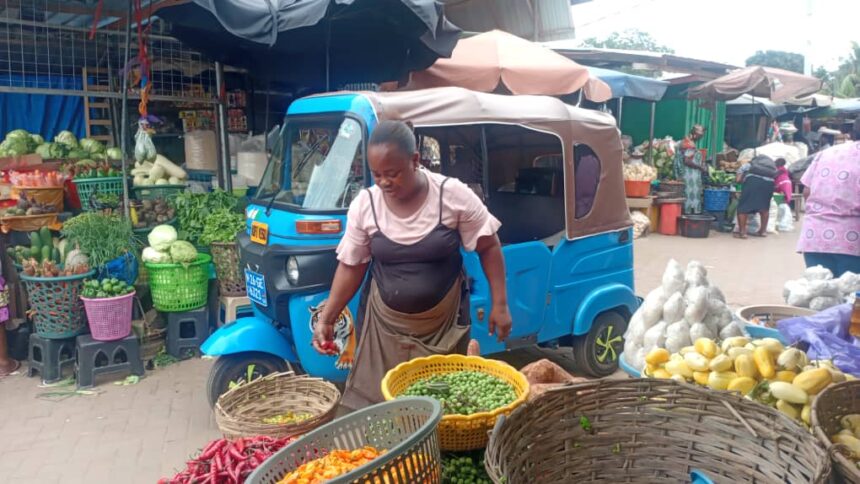
Mariama sees a future where the market becomes a thriving hub. A place where many people want to start their own businesses and where the market itself expands.
But her vision goes deeper than commerce. She regularly organizes programs that encourage community members, especially women, to step into leadership roles themselves.
“I often organize programs that would encourage them to also partake in leadership roles,” she said.
Mariama didn’t set out to be a unionist or a leader. She simply saw a need and volunteered. But in becoming the bridge between her community and those in authority, she didn’t just solve a problem. She showed an entire community what courage looks like.